Biography
Shinohara came to architecture through mathematics. Born in Shizuoka Prefecture, he graduated with a degree in mathematics from the Tokyo School of Physics in 1947 and then transferred to the Tokyo Institute of Technology to study architecture, where he studied under Kiyoshi Seike and graduated in 1953. He remained there—serving as a professor from 1970 until his retirement in 1986—and shaped an entire generation of architects.
“A house is a work of art,” was his motto, and he devoted most of his energy to small residential buildings. The “Umbrella House” (1961) was relocated to the Vitra Campus in Weil am Rhein in 2022. The House in White (1966) is considered his key work: a square floor plan, a pyramidal roof, white walls, and a symbolic column in the large room. In the House in Uehara (1976), he further developed the motif of the freestanding column into a massive, truss-like structure inside. His most important public building is the Centennial Hall at the Tokyo Institute of Technology (1987), whose interpenetrating volumes and metal surfaces are reminiscent of machines.
As Alberto Dell’Antonio and Tibor Joanelly summarize, Kazuo Shinohara himself divided his own work into four styles. Starting from the Japanese tradition, his exploration of architecture led him through abstraction to deconstructivism and ultimately to the conditions of chaos and virtualization of today. As an architect who both wrote and built, he was driven to test theoretical postulates in his buildings and designs. Furniture remains a marginal aspect of his work. One of his best-known designs is the “Miss Butterfly” chair (1985). Quittenbaum has auctioned the “Highnoon” armchair from 1985 on several occasions. In 1988, he published an essay on furniture design titled “Furniture = Geometry around the Body.”
Objects by Kazuo Shinohara
-
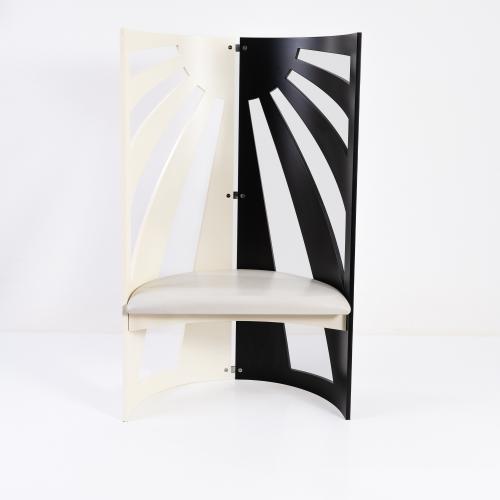
Kazuo Shinohara Sawaya & Moroni, Mailand / Milan
Armchair 'Highnoon', 1984 (design)
Estimate: 4,000 € - 4,500 €
-
Sold

