Biography
Pierre Chareau is one of the most influential architects and designers of the European avant-garde between the two world wars. He began his career at the age of 16 as a furniture designer at the London firm Waring & Gillow and, although he had no formal degree, studied painting, music, and architecture at the École des Beaux-Arts in Paris. In 1919, he founded his own studio and opened the gallery “La Boutique” in Paris in 1924, where he sold his own furniture and lighting fixtures.
Chareau is best known for the Maison de Verre (1928–1931), the Glass House, which he built in collaboration with his fellow architect Bernard Bijvoet for the gynecologist Dr. Dalsace and his wife. The house in the 7th arrondissement is an icon of modern architecture. The structure of metal columns with open and flexible spaces is clad in a minimalist façade of square glass blocks. Inside, Chareau’s furniture designs create accents that are at times contrasting. His design language combines the legacy of Art Deco with constructive forms and select materials such as fine woods, steel, glass, and alabaster. With its innovative, transparent, and functional spaces, the building is a significant landmark of French Modernism.
Pierre Chareau was also very active in the social and political spheres; he was a co-founder of the French avant-garde groups Congrès International d’Architecture Moderne (CIAM) and Union des Artistes Modernes (UAM), which also included Le Corbusier and Charlotte Perriand.
In the late 1930s, he emigrated to the United States and moved to New York, where he continued to work on smaller projects until his death in 1950; for example, he built a house for the painter Robert Motherwell in the Hamptons. Today, some of his designs are produced as collector’s editions by Ecart International.
Objects by Pierre Chareau
-
Sold
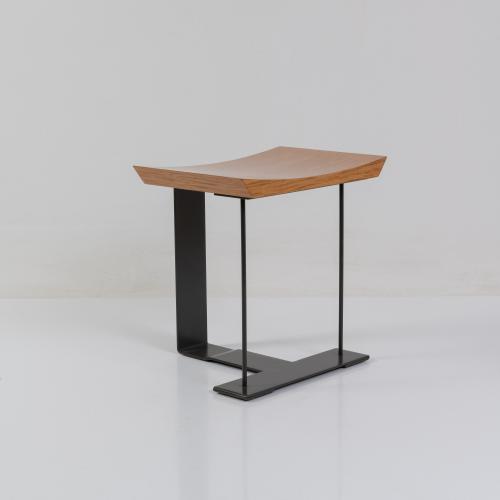
Pierre Chareau Ecart International, Paris
Stool 'SN 3 - T- Stool', 1927 (design)
Hammer Price: 2,000 €
-
Sold
-
Sold